






Introduction
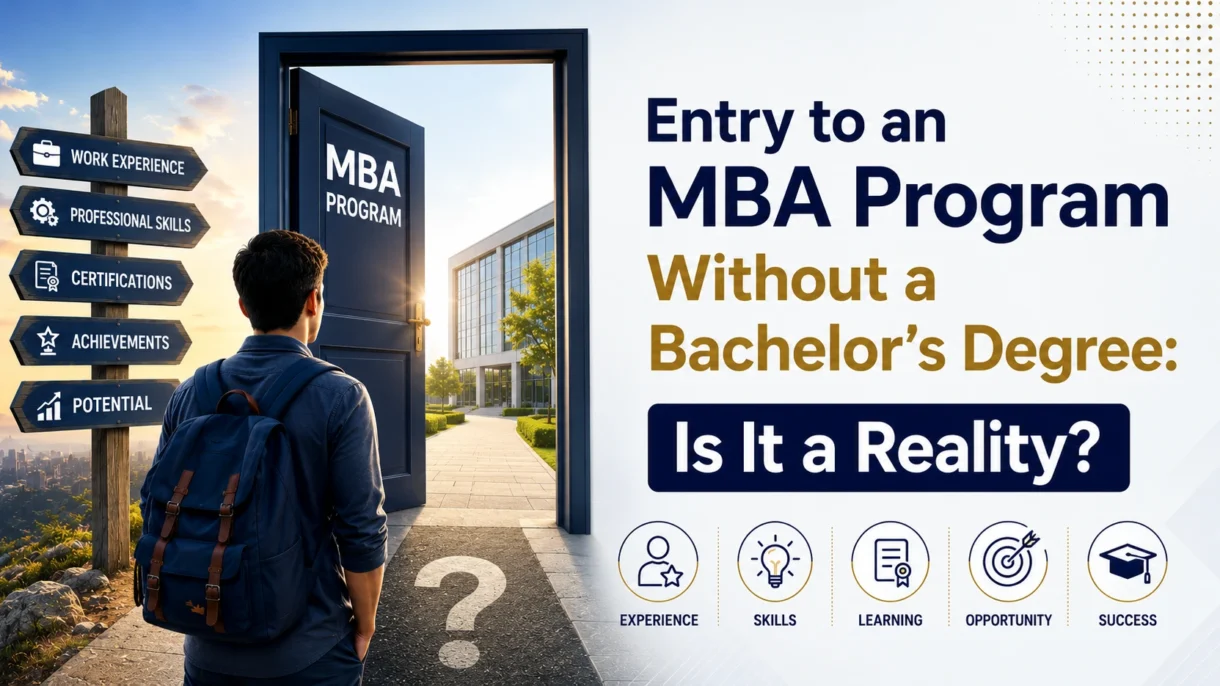
The Master of Business Administration (MBA) is often considered the highest educational level expected of a business leader. Many professionals seek and in some cases, gain entry to an MBA program despite not possessing a foundational Bachelor’s degree. In absence of bachelor degree, professions who undergo a MBA directly may not fully grasp the concepts and analytical frameworks that underpin the discussion and application of theories in a MBA class; as A) the class may be fast-paced, B) the MBA program could be completed in as short timeframe and C) the cohort could comprise primarily of experienced mid level manager, eager to immediately translate classroom knowledge gained to their workplace practice.
Furthermore, on the receiving end, the credential of the MBA degree without a foundational Degree, by the employer, may be perceived as dubious and invite questions regarding academic progression or recognition. In some cases, employers, as a standard practice, may not recognize a Masters degree if that is not backed by a relevant Bachelors degree.
1. How Does Academic Readiness Affect Success in an MBA Program?
To meet the needs in the Industry, an MBA is designed as an advanced management qualification, to foster and enhance strategic thinking, leadership and problem-solving skills. MBA programs generally assume that learners already possess foundational knowledge in areas of organizational behavior, marketing and accounting and competencies in quantitative analysis and business research.
On the other hand, a bachelor’s degree serves as the foundation stage where core competencies are introduced and developed. So it can be argued that professionals entering an MBA without may still bring their valuable workplace experience; however, experience is not a substitute for the academic foundation essential to comprehend theoretical models or construct evidence-based arguments at the postgraduate level.
2. How Does Your Academic Pathway Affect Recognition, Employability, and Career Mobility?
A good test of the value of any qualification is often reflected in the opportunities it creates. So while an MBA obtained through experience-based entry may be considered as authentic in certain industries or organizations, its acceptance may depend on the policies of organization, jurisdiction, and professional positions.
Employer Expectations: A significant majority of employers, particularly large multinational organizations, prefer a conventional academic progression from undergraduate to postgraduate, viewing that academic consistency and structured development as the evidence of professional capability and reliability.
Recruitment Screening Systems: Given the advancement of IT and digitalization, recruitment platforms strictly adhere to set use automated screening criteria, where some roles may list a degree as an eligibility requirement, limiting applicants to certain opportunities.
International Mobility: For certain sectors in GCC countries, like the UAE or Bahrain, employment visas, immigration assessments, professional licensing, or credential recognition processes may scrutinize the full academic pathway, potentially flagging off the absence of a bachelor’s degree as a relevant consideration.
3. Why Does the Order of Your Academic Journey Matter?
The distinction between undergraduate and MBA education lies not merely in level, but in learning purpose and academic progression.
| Feature | Undergraduate Education | MBA Education |
| Primary Goal | Foundational knowledge and subject specialization | Strategic application and leadership development |
| Learning Style | Theory-oriented and structured learning | Applied, case-based, and decision-focused learning |
| Career Focus | Entry-level and specialist roles | Management and leadership roles |
| Academic Development | Builds analytical and research foundations | Applies prior knowledge to business challenges |
4. Why Does Earning a Bachelor’s Degree First Offer Greater Long-Term Benefits?
For most learners, undergoing a bachelor’s degree program before pursuing an MBA provides them with a much-needed stronger academic foundation, based on which they can surge ahead comfortably with a fast-paced advanced program.
How Does a Bachelor’s Degree Improve Academic Preparedness for an MBA?: A BBA degree program develops analytical, business functional and academic writing skills that enable success at the MBA level.
How Can a Bachelor’s Degree Strengthen Your Career Profile?: A well-formulated and structured academic journey combining various business functional knowledge at the undergraduate level with strategic management education at the postgraduate level often creates an integrated system of knowledge needed for a professional at his workplace.
How Does a Bachelor’s Degree Support Future Academic Progression?: For those considering Ph.D, lecturing, or academic research in the future, a conventional undergraduate-to-postgraduate pathway is most advantageous and, in most cases, a mandatory requirement for entry.
Conclusion: Speed vs. Scope
Although a direct entry into an MBA without securing a bachelor’s degree may be legitimate in certain educational systems, especially for experienced working professionals, learners should carefully evaluate whether the benefits in terms of speed of qualification and the breadth of studies in the curriculum eventually align with their long-term career goals.
It may be safe to conclude that such pathways serve specific professional or business objectives, but it should be borne in mind that the proper academic route often provides broader recognition, greater international flexibility, and stronger academic depth. In the final analysis, the apt choice depends not merely on gaining the qualification, but on which doors will be kept wide open for the Learner.
